
News Articles & Press Archive
In this section of the site we will highlight news and press updates as well as feature recent research and blog posts. Check back often for the latest on all things nano.
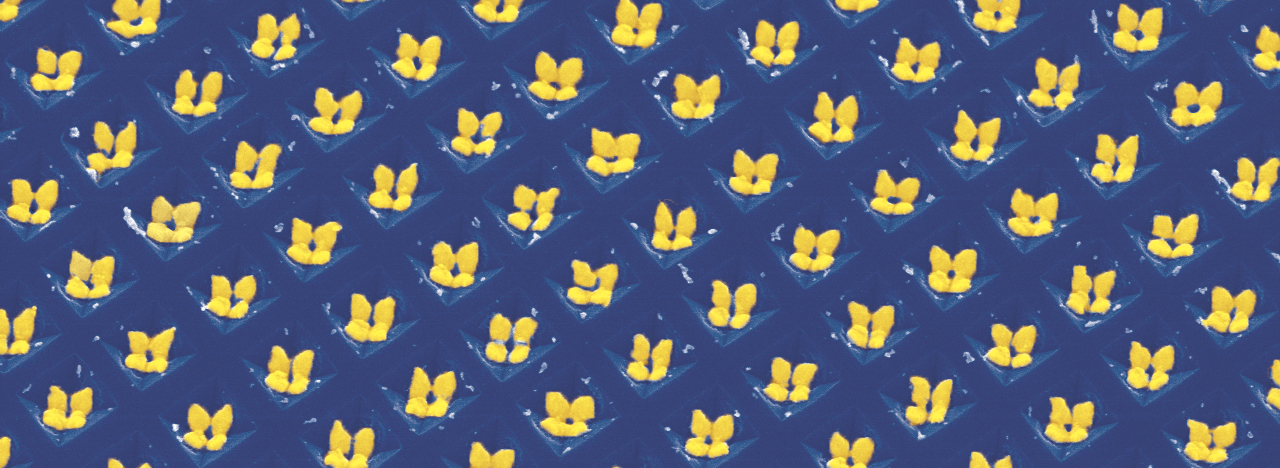
Ultralong-range Interactions in Moiré Photonic Lattices
The combination of multiple periodic structures to create moiré patterns holds great potential for controlling and manipulating light. However, the effects and interactions associated with moiré patterns have been limited to the immediate vicinity of these patterns....
Nanoparticle Shape Determines Dynamics of Targeting Nanoconstructs on Cell Membranes
Nanoparticle shape plays an important role in targeted drug delivery. Investigations of how differences in morphology affect nanoparticle-cell interactions at the single-particle level—especially internalization and cellular trafficking—are critical yet limited. Using...
Quantum Dot-Plasmon Lasing with Controlled Polarization Patterns
The tailored spatial polarization of coherent light beams is important for applications ranging from microscopy to biophysics to quantum optics. Miniaturized light sources are needed for integrated, on-chip photonic devices with desired vector beams; however, this...
Reconfigurable Graphene Wrinkles with Area-Specific Structural Features
Graphene exhibit unique electronic properties and mechanical flexibility that are beneficial for next-generation electronics. Crumpling graphene on elastomer sheets can engineer the properties depending on wavelength and orientation while maintaining structural...
Continuous-wave Upconverting Lasing from Sub-wavelength Plasmons
Continuous-wave (CW) lasing at room temperature is critical for integration with opto-electronic devices and optimal modulation of optical interactions. Plasmonic nanocavities integrated with gain can generate coherent light at sub-wavelength scales, while...
Graphene Wrinkles Enable Spatially Defined Chemistry
Selectively functionalized graphene can realize spatially defined properties that are highly desirable for atom-thin devices. We developed a scalable approach to realize area-specific properties in graphene using multiscale wrinkles. Patterned areas of graphene...
Lattice-Resonance Metalenses for Fully Reconfigurable Imaging
Metalenses are compact lensing components based on rationally designed nanoscale building blocks. These planar devices are crucial for miniaturized imaging systems that can be integrated into portable electronic and optical devices. However, existing metalenses have...
Stretchable nanolasers from hybrid quadrupole plasmons
We achieved mechanical control of the lasing color by exploiting a lasing cavity based on periodic arrays of nanoparticles in a stretchable, polymer matrix. This materials system could achieve reversibly tunable lasing as well as superior sensitivity to applied...
Detecting and Visualizing Reaction Intermediates of Anisotropic Nanoparticle Growth
Understanding the underlying mechanism for the synthesis of metallic nanoparticles is crucial for strategic creation of desirable particles. We have recently designed a correlative approach to detect, visualize, and characterize intermediate species during a seedless,...
Band-Edge Engineering for Controlled Multi-Modal Nanolasing in Plasmonic Superlattices
Miniaturized lasers enable applications in on-chip optical communication, medical imaging, and nanoscale optical displays. Compared to traditional lasers, plasmonic nanolasers can break the diffraction limit and support ultrasmall mode volumes, but unwanted...
Evolutionary Design and Prototyping of Single Crystalline Titanium Nitride Lattice Optics
Plasmonic metasurfaces—structured materials with subwavelength units—are of interest for applications ranging from high resolution imaging to 3D holography. Integrated devices, however, are challenging to achieve because traditional plasmonic materials such as Ag or...
Multiscale, Hierarchical Patterning of Graphene by Conformal Wrinkling
Patterning three-dimensional (3D) structure into two-dimensional (2D) graphene is important for applications in flexible electrodes, stretchable electronics and energy storage devices. We have demonstrated a conformal wrinkling process that can generate hierarchical...
Stretchable superhydrophobicity from monolithic, three-dimensional hierarchical wrinkles
Superhydrophobic surfaces that can also withstand mechanical deformation such as bending and stretching are important for applications such as robust self-cleaning, water-resistant electronics, and flexible microfluidics. We developed monolithic, multi-scale...
Screening New Plasmonic Materials
Surface plasmon polaritons (SPPs) are responsible for exotic optical phenomena including negative refraction, surface enhanced Raman scattering, and nanoscale focusing of light. Although many materials support SPPs, the choice of metal for most applications has been...
The Dark Side of Surface Plasmons
Plasmonic nanostructures concentrate optical fields into nanoscale volumes, which is useful for plasmonic nanolasers, surface enhanced Raman spectroscopy, and white-light generation. However, the short lifetimes of the emissive plasmons correspond to a rapid depletion...
Superlatice Plasmons in Hierarchical Au Nanoparticle Arrays
Periodic metal nanoparticle (NP) arrays support narrow lattice plasmon resonances that can be tuned by changing the localized surface plasmons of the individual NPs in the array, NP periodicity, and dielectric environment. The high quality factors (100-200) of lattice...
Teri Odom Honored
Teri Odom was honored at an Investiture Ceremony of Endowed Chairs.
Controlled Three-Dimensional Hierarchical Structuring by Memory-Based, Sequential Wrinkling
Strain-induced wrinkling of a stiff skin on a soft base layer is emerging as a powerful bottom-up method to realize ordered and disordered patterns across an entire surface. We have developed a memory-based, sequential wrinkling process that can transform flat...
Real-time Tunable Lasing from Plasmonic Nanocavity Arrays
Plasmon lasers can support ultrasmall mode confinement and ultrafast dynamics with device feature sizes below the diffraction limit. However, most plasmon-based nanolasers rely on solid gain materials (inorganic semiconducting nanowire or organic dye in a solid...
Hetero-oligomer Nanoparticle Arrays for Plasmon-Enhanced Applications
Plasmonic nanoparticles (NPs) arranged into assemblies can manipulate near-field profiles and modify far-field characteristics compared to a single NP. The ability to tune each nanoparticle in a plasmonic assembly can reveal new architectures for plasmon-enhanced...
A Simple Method to Enhance Therapeutic Efficacy of Nanoconstructs
Apt-AuNS nanoconstructs composed of two primary components, an anisotropic gold nanostar (AuNS) core and a shell of secondary structure aptamer, AS1411, have shown great potential in cancer treatment. The high density of AS1411 that comprise the shell results in a...
Nanowrinkles on polymer substrates
Nanotexturing polymeric surfaces changes their surface properties while their bulk properties remain unchanged. Wrinkles and folds can increase the efficiency and mechanical stability of optical and electrical devices. We have found a parallel method to create...
Nanoconstructs for Cancer Therapeutics
Direct visualization of interactions between drug-loaded nanoparticles and the cancer cell nucleus is crucial for understanding the mechanism behind cancer cell death. Nanoconstructs composed of nucleolin-specific aptamers and gold nanostars were actively transported...
Photolithography on the Benchtop
Solid-state photolithography (SSP) enables the capabilities of one of the most important tools in nano- and microfabrication, the mask aligner, to be performed on the benchtop. SSP can create patterns over a wide range of different length scales (down to several...
Nested Pyramidal Nanoshells
We are investigating the optical properties of 3D anisotropic plasmonic particles. Recently, we have designed a way to create nested Au pyramidal nanoshells. These particles exhibit two plasmon resonances at visible and near-infrared wavelengths that can be...
Multifunctional Plasmonic Particles
We are working on a new class of asymmetric metal particles: nanofabricated pyramids. Because their nanofabrication procedure is extremely versatile, pyramids are ideal for designing multifunctional plasmonic materials that have high potential for creating unexpected...
Plasmonic Metamaterials
The interaction of light with surface plasmons — collective oscillations of free electrons — in metallic nanostructures leads to novel optical phenomena. These structures typically consist of ordered arrays of particles or holes with sizes of the order of 100 nm....
Chemical Nanofabrication
We have combined bottom-up chemical methods and top-down nanoscale patterning techniques—chemical nanofabrication—to generate patterned and free-standing transition metal chalcogenide (TMC) nanostructures. This approach is general and flexible and can produce (1)...
Direct Evidence for Surface Plasmon-Mediated Enhanced Optical Transmission through Nanohole Arrays
By combining near-field and far-field spectroscopy, we have provided direct evidence for the role of surface plasmons (SPs) in the enhanced optical transmission of light through metallic nanoscale hole arrays. Near-field optical images directly confirmed the presence...
Nanocrystals in Nanowells
Nanoscale fabrication methods provide a unique approach to synthesize nanoscale materials. We have used laser-assisted embossing to generate close-packed arrays of hemispherical nanowells with zeptoliter (zL)-volumes. Nanowells with diameters as small as 50 nm were...
News & Press Mentions
- April 2024: Teri is named 2024 Guggenheim Fellow for Chemistry
- January 2024: Teri is awarded the 2024 SPIE Mozi Award.
- November 2023: Nathan Sinai and Tiffany Zheng are awarded HMCP Fellowships at Northwestern University.
- August 2023: Teri has been recognized as a SPIE Senior Member.
- June 2023: Sang-Min Park has been named as a Ryan Fellow at Northwestern University.
- May 2023: Teri has been elected to the National Academy of Science (NAS).
- February 2023: Jun’s paper, “Far-field coupling between moiré photonic lattices” was published in Nature Nanotechnology.
- January 2023: Jack was named Best Presenter of the Biomedical Materials and Biosensors session of the ICNMS Conference.
- October 2022: Alex’s paper tittled “Polariton Formation from Soret Band Excitons in MetalOrganic Frameworks and Plasmonic Lattices” has been published in the J. Phys. Chem. C.
- October 2022: Read the introduction to Chem. Rev.‘s special issue on the Chemistry of Metamaterials, authored by Teri Odom and Cheng-Wei Qiu of the National University of Singapore.
- July 2022: Max’s article “Lasing Action from Quasi-propagating Modes” has been published in Adv. Mater.
- July 2022: Max Tan is currently being featured on the Northwestern’s TGS Spotlight.
- June 2022: Max Tan has been named as a Ryan Fellow at Northwestern.
- May 2022: Shikai’s article “Interfacial Engineering of Plasmonic Nanoparticle Metasurfaces” has been published in PNAS.
- March 2022: Kwahun’s article “Delivery Order of Nanoconstructs Affects Intracellular Trafficking by Endosomes” has been published in J. Am. Chem. Soc.
- March 2022: Priscilla’s article “Investigating Reaction Intermediates during the Seedless Growth of Gold Nanostars Using Electron Tomography” has been published in ACS Nano.
- March 2022: Jeong-Eun’s article “Polariton Dynamics in Two-Dimensional Ruddlesden-Popper Perovskites Strongly Coupled with Plasmonic Lattices” has been published in ACS Nano.
- February 2022: Teri was elected to the American Institute for Medical and Biological Engineering College of Fellows. She is being recognized for the “development of optical nanoprobes based on anisotropic metal nanoparticles for bioimaging and therapeutics.”
- January 2022: Xitlali’s article “M-Point Lasing in Hexagonal and Honeycomb Plasmonic Lattices” has been published in ACS Photonics.
- December 2021: Collaborative work between the members of the Jacobs group at Purdue and Odom Group members, “Long-Range Dipole-Dipole Interactions in a Plasmonic Lattice” has been published in Nano Lett.
- November 2021: Lucy’s article, “Programmable Self-Regulation with Wrinkled Hydrogels and Plasmonic Nanoparticle Lattices” has been published in Small.
- September 2021: Collaborative work between Nicholas E. Watkins of the Schaller Group and Odom Group members, “Surface Normal Lasing from CdSe Nanoplatelets Coupled to Aluminum Plasmonic Nanoparticle Lattices” has been published in J. Phys. Chem. C.
- September 2021: Alex’s article,”Strong Coupling Between Plasmons and Molecular Excitons in Metal-Organic Framework,” has been publishd in Nano Letters.
- September 2021: Jun’s article, “Plasmonic Nanoparticle Lattice Devices for White-Light Lasing,” has been published in Advanced Materials.
- May 2021: Tad’s article, “Ultrafast Spectroscopy of Plasmonic Titanium Nitride Nanoparticle Lattices,” has been published in ACS Photonics.
- April 2021: Collaborative work between previous group members Jian Zhang, Won-Kyu Lee, and Dongjoon Rhee and Hangzhou Dianzi (University in China), “Spontaneous Formation of Ordered Magnetic Domains by Patterning Stress,” has been published in Nano Letters.
- April 2021: Priscilla’s recent publication, “Nanoparticle Shape Determines Dynamics of Targeting Nanoconstructs on Cell Membranes,” has been highlighted in the latest edition of JACS Spotlights article “The Hidden Role of Nanoparticle Shape in Biological Interactions.”
- March 2021: Teri hosted International Institute for Nanotechnology’s (IIN) Frontiers in Nanotechnology virtual mini-conference featuring exciting new research in nanophotonics, from biochemistry to energy and electronics.
- March 2021: Priscilla’s article, “Nanoparticle Shape Determines Dynamics of Targeting Nanoconstructs on Cell Membranes,” has been published in JACS.
- March 2021: Jun’s article, “Identification of Brillouin Zones by In-Plane Lasing from Light-Cone Surface Lattice Resonances,” has been published in ACS Nano.
- March 2021: As part of the International Women’s Day 2021 (8 March) celebration, Teri shared her ‘day in the life’ in The Nanomed Zone. The article is entitled, “Designing structured nanoscale materials that exhibit extraordinary properties: a day in the life of Teri Odom.”
- March 2021: Emma’s article, “Light-Mediated Directed Placement of Different DNA Sequences on Single Gold Nanoparticles,” has been published in JACS.
- January 2021: Danqing has been featured in the Miller Fellow Focus article “Structuring Nanomaterials for Optics” by the Miller Institute.
- January 2021: Jeong-Eun has been highlighted in the “Nanotechnology at Northwestern” feature by the International Institute for Nanotechnology.
- January 2021: Shikai’s article, “Plasmonic Photoelectrocatalysis in Copper–Platinum Core–Shell Nanoparticle Lattices,” has been published in Nano Letters.
- December 2020: Shikai has been highlighted in the “Nanotechnology at Northwestern” feature by the International Institute for Nanotechnology.
- December 2020: Dongjoon’s article, “Soft Skin Layers for Reconfigurable and Programmable Nanowrinkles,” has been published in Nanoscale.
- December 2020: Danqing Wang was named Forbes 30 Under 30 in the category of Science for 2021.
- November 2020: Max (Jin Hui) Tan received the Hierarchical Materials Cluster Program (HMCP) Fellowship by The Graduate School at Northwestern University.
- November 2020: Jingtian’s article, “Single-Nanoparticle Orientation Sensing by Deep Learning,” has been published in ACS.
- November 2020: Jun Guan received the 2020 Outstanding Researcher Award sponsored by the International Institute for Nanotechnology at Northwestern University.
- September 2020: Shikai’s article, “Ultranarrow plasmon resonances from annealed nanoparticle lattices,” has been published in PNAS.
- September 2020: Jun Guan has been awarded a Terminal Year Fellowship sponsored by the McCormick School of Engineering at Northwestern University.
- August 2020: Shikai Deng has been awarded a Cottrell Fellowship sponsored by the Research Corporation for Science Advancement (RCSA).
- July 2020: Kwahun’s article, “Endosomal Organization of CpG Constructs Correlates with Enhanced Immune Activation,” has been published in Nano Letters.
- June 2020: Teri shared her insights about the importance of teamwork in interdisciplinary research. The article is entitled, “Without team it’s just work.”
- June 2020: Teri has been awarded a 2020 Centenary Prize from the Royal Society of Chemistry for seminal work on multi-scale materials that enable new ways to achieve ultrafast, coherent, and directional light emission at the nanoscale.
- June 2020: Ravindra’s article, “Strongly Coupled Exciton−Surface Lattice Resonances Engineer Long-Range Energy Propagation,” has been published in Nano Letters.
- June 2020: Jeong-Eun Park has been selected to receive a Postdoctoral Fellowship sponsored by the National Research Foundation of Korea.
- May 2020: Teri was named Crain’s Chicago Business 2020 Notable Women in STEM.
- May 2020: Jingtian Hu and Bowei Zhang have been awarded the Chinese government award for outstanding self-financed students abroad established by the China Scholarship Council in 2003.
- May 2020: Teri discussed her insights in laser research in Optics & Photonics News. The article is entitled, “The Laser at 60.”
- April 2020: Teri has been elected a member of the American Academy of Arts and Sciences! See all new members here and profiles of the eight Northwestern faculty members elected here.
- April 2020: Lele Mathis has been selected to receive a 2020 National Defense Science and Engineering Graduate (NDSEG) Fellowship Award!
- March 2020: The group’s paper, “Separation of Stabilized MOPS Gold Nanostars by Density Gradient Centrifugation,” has been included in ACS Omega‘s first-ever Virtual Issue, “Women at the Forefront of Chemistry.”
- March 2020: Priscilla’s collaborative paper with the University of Colorado, “Plasmonic nanostar photocathodes for optically-controlled directional currents,” has been published in Nature Communications.
- February 2020: Danqing’s paper, “Lasing from Finite Plasmonic Nanoparticle Lattices,” has been published in ACS Photonics.
- February 2020: The group’s collaborative paper with Nanyang Technological University, “Thermal‐Disrupting Interface Mitigates Intercellular Cohesion Loss for Accurate Topical Antibacterial Therapy,” has been published in Advanced Materials.
- February 2020: Jun’s latest publication, “Quantum Dot-Plasmon Lasing with Controlled Polarization Patterns,” has been published in ACS Nano.
- January 2020: Jun’s article, “Engineering Directionality in Quantum Dot Shell Lasing Using Plasmonic Lattices,” has been published in Nano Letters.
- January 2020: Dongjoon’s recent publication, “Soft Skin Layers Enable Area-Specific, Multiscale Graphene Wrinkles with Switchable Orientations,” has been highlighted in an ACS Nano article, “Getting the Hole Story on Molecular Binding to Nanopore Edges.”
- January 2020: Teri’s selection as Nano Letters Editor-in-Chief has been celebrated in a Nature Nanotechnology editorial.
- January 2020: Lucy’s article, “Strain-Dependent Nanowrinkle Confinement of Block Copolymners,” has been published in Nano Letters.
- January 2020: Teri and the other 2020 ACS National Award winners were highlighted by Chemical & Engineering News.
- November 2019: The group’s nanolaser research was spotlighted by Communique, the internal Office of Science newsletter.
- November 2019: Teri has been named as the new editor-in-chief of Nano Letters! Read the announcement from ACS and more in Chemical & Engineering News.
- November 2019: Teri has been named as the new editor-in-chief of Nano Letters! Read more here.
- November 2019: Dongjoon’s article, “Soft Skin Layers Enable Area-Specific, Multiscale Graphene Wrinkles with Switchable Orientations,” has been published in ACS Nano.
- October 2019: Xianyu’s article, “Enhanced Fields in Mirror-backed Low-Index Dielectric Structures,” has been published in ACS Photonics.
- October 2019: The group’s joint work with the Mirkin Group, “Massively Parallel Nanoparticle Synthesis in Anisotropic Nanoreactors,” has been published in ACS Nano.
- October 2019: The group’s joint biocompatible nanolaser work with Columbia University has been highlighted by springwise.com and the Berkeley Lab’s Molecular Foundry.
- October 2019: Danqing’s article, “Manipulating Light–Matter Interactions in Plasmonic Nanoparticle Lattices,” was published in Accounts of Chemical Research.
- September 2019: Danqing’s article, “Ultralow-threshold, continuous-wave upconverting lasing from subwavelength plasmons,” has been published in Nature Materials and highlighted by Northwestern Now, Laboratory News, and News & Views.
- August 2019: Teri has been awarded the 2020 ACS Award in Surface Chemistry! See a list of all 2020 national award winners here.
- August 2019: Yuanhai’s new article, “Engineering Symmetry-Breaking Nanocrescent Arrays for Nanolasing,” has been published in Advanced Functional Materials.
- August 2019: Roger’s article, “Using Good’s Buffers To Control the Anisotropic Structure and Optical Properties of Spiky Gold Nanoparticles for Refractive Index Sensing,” has been published in ACS Applied Nano Materials.
- August 2019: Ran’s article, “Hierarchical Hybridization in Plasmonic Honeycomb Lattices,” has been published in Nano Letters.
- August 2019: Debanjan’s new article, “Resolving Single-Nanoconstruct Dynamics during Targeting and Nontargeting Live-Cell Membrane Interactions,” has been published in ACS Nano and featured in Northwestern Now.
- July 2019: Jingtian has been highlighted in the “Nanotechnology at Northwestern” feature by the International Institute for Nanotechnology.
- July 2019: Teri was featured in an Optics & Photonics News article commemorating the 60th anniversary of Richard Feynman’s historic lecture, “There’s Plenty of Room at the Bottom.” The article is entitled, “Still Plenty of Room at the Bottom.”
- June 2019: Michael’s paper, “Polarization-Dependent Lasing Behavior from Low-Symmetry Nanocavity Arrays,” has been highlighted in an ACS Nano Perspective article.
- June 2019: Roger’s article, “Manipulating Immune Activation of Macrophages by Tuning the Oligonucleotide Composition of Gold Nanoparticles,” has been published in Bioconjugate Chemistry.
- June 2019: Ran published a paper in Journal of the Optical Society of America B entitled “Plasmon nanolasing with aluminum nanoparticle arrays [Invited].”
- June 2019: Weijia’s paper, “Ultrafast Dynamics of Lattice Plasmon Lasers,” was published in The Journal of Physical Chemistry Letters.
- June 2019: Won-Kyu and Teri published an article in ACS Nano entitled “Designing Hierarchical Nanostructures from Conformable and Deformable Thin Materials.”
- May 2019: Teri was recognized for her selection as a 2019 Fellow of The Optical Society (OSA). See a photo of the ceremony here.
- April 2019: Danqing Wang has been awarded a prestigious Miller Fellowship by the University of California, Berkeley.
- April 2019: Xitlali Juarez and Alex Sample received Honorable Mention recognitions from the NSF Graduate Research Fellowship Program (GRFP).
- April 2019: Teri discussed her path to interdisciplinary research and advice for aspiring scientists in Physics Today.
- March 2019: The group’s latest paper, “Lattice-Resonance Metalenses for Fully Reconfigurable Imaging,” has been featured by Northwestern Now.
- March 2019: Teri has been profiled in ACS student member magazine inChemistry in anticipation of her Eminent Scientist Lecture at the Spring 2019 ACS National Meeting.
- January 2019: Research from the group was included in a new article, The Dawn of New Optics: Emerging Metamaterials, on photonics.com.
- December 2018: Two new articles from the group have been published: one on hierarchical wrinkles in Langmuir and another on surface lattice resonances in Nano Letters.
- November 2018: The group’s research for the Air Force Center of Excellence for Advanced Bioprogrammable Nanomaterials is highlighted here.
- November 2018: Group member Danqing Wang has been highlighted in a feature by Northwestern’s International Institute for Nanotechnology.
- October 2018: Teri has been elected to the 2019 Fellows Class of The Optical Society (OSA).
- October 2018: In celebration of the 30th Anniversary of the Packard Fellowship for Science and Engineering, the Packard Foundation released a video featuring Teri and some of her Packard Fellow colleagues.
- September 2018: Teri has been elected a 2018 Fellow of the American Physical Society (APS).
- September 2018: Teri has been highlighted in a special virtual issue, Bioconjugate Chemistry: Celebrating Women Scientists.
- September 2018: Teri’s recent talk at The Optical Society’s Frontiers in Optics/Laser Science meeting has been featured in Optics & Photonics News.
- August 2018: Read “Teri Odom on Being an Advocate” in the latest issue of Senior Member Insights from Optics & Photonics News.
- August 2018: The group’s paper, “Correlating Nanoscopic Energy Transfer and Far-Field Emission to Unravel Lasing Dynamics in Plasmonic Nanocavity Arrays,” was featured in a special virtual issue of ACS Nano entitled “Women in Nanotechnology: Toward Better Materials through a Better Understanding of Low-Dimensional Systems.”
- July 2018: Young-Ah (Lucy) Lee has been selected as an International Institute for Nanotechnology Ryan Fellow!
- June 2018: The group’s chameleon-inspired nanolaser has been highlighted by Chemical & Engineering News, Electronics Weekly, Laboratory News (UK), Nanowerk, New Atlas, Northwestern Now, Photonics.com, Physics World, ScienceDaily, and WTTW. It has also been featured on the National Science Foundation’s homepage and as a Chicago Biomedical Consortium Success Story!
- June 2018: Teri Odom has been welcomed to The Optical Society (OSA) 2018 Class of Senior Members.
- April 2018: Nic Watkins has been awarded an NSF Graduate Research Fellowship!
- March 2018: North by Northwestern article “Chemistry, but Make it Small” featured Teri and other Northwestern nanoscientists.
- March 2018: Check out “Teri W. Odom’s Personal Story of Discovery” from the ACS here!
- February 2018: Teri Odom has been named one of three Cottrell Scholar TREE Award recipients for 2018 by Research Corporation for Science Advancement.
- January 2018: Danqing Wang has been selected as a recipient of the prestigious Chinese Government Award for Outstanding Self-Financed Students Abroad.
- November 2017: The group’s paper, “Manipulating the Optical Properties of Pyramidal Nanoparticle Arrays,” has been included in a special collection of papers honoring the 150th birthday of Marie Curie, as well as highlighting the science and publications by 66 women scientists and researchers who have published in The Journal of Physical Chemistry.
- November 2017: Teri Odom was selected by the Northwestern Associated Student Government (ASG) for the 2017 – 2018 Faculty Honor Roll.
- October 2017: Teri hosted an ACS webinar for National Nano Day entitled “Nano 2.0: Multi-scale Nanomaterials.” Watch it here!
- October 2017: Teri Odom and Chad Mirkin were featured in Northwestern Now article “Titans of nanotechnology: The next big thing is very small.”
- September 2017: The group’s latest paper, “Sequential Feature-Density Doubling for Ultraviolet Plasmonics,” has been selected as an ACS Editors’ Choice article.
- August 2017: Teri received a 2017 ACS Nano Lectureship Award and gave a presentation at ChinaNANO in Beijing. See a photo of the winners.
- August 2017: The group’s newest paper, “Concurrent design of quasi-random photonic nanostructures,” and collaborative work with Professor Wei Chen’s lab were highlighted in Nanowerk, Nanotechnology Now, Northwestern Engineering News, NanotechWeb, Engineering 360, LaserFocusWorld, EurekAlert!, and ScienceDaily.
- July 2017: Northwestern News article, “New laser design offers more inexpensive multi-color output,” details the group’s exciting progress in developing a more cost-effective laser design.
- July 2017: The group’s newest paper, “Band-edge engineering for controlled multi-modal nanolasing in plasmonic superlattices,” has been highlighted by Nanowerk, Opli, Photonics Media, Digital Journal, AZO Optics, and Nature Nanotechnology‘s News and Views.
- April 2017: Won-Kyu Lee has received a Materials Research Society (MRS) Graduate Student Gold Award following his presentation at the MRS Spring Meeting in Phoenix, AZ.
- March 2017: Teri has been selected by the Department of Defense as one of only 13 Vannevar Bush Faculty Fellows.
- March 2017: The group’s paper, “Coherent Light Sources at the Nanoscale,” will be included in Volume 68 of the Annual Review of Physical Chemistry.
- March 2017: Jingtian’s image from the group’s recent paper, “Evolutionary Design and Prototyping of Single Crystalline Titanium Nitride Lattice Optics,” was selected as the cover image for the March issue of ACS Photonics.
- March 2017: Research featured in the group’s paper, “Evolutionary Design and Prototyping of Single Crystalline Titanium Nitride Lattice Optics,” is highlighted in MRS Bulletin.
- February 2017: Teri and Brian Odom are highlighted in a “Couples of Northwestern” special feature.
- January 2017: The group’s newest paper, “Evolutionary Design and Prototyping of Single Crystalline Titanium Nitride Lattice Optics,” has been published in ACS Photonics and featured in Nanowerk.
- December 2016: The group’s recent paper on programmable plasmon modes has been highlighted on NanotechWeb.
- November 2016: The group’s paper, “Programmable and Reversible Plasmon Mode Engineering,” has been featured in Nanowerk.
- November 2016: Won-Kyu Lee is selected as a 2016 Ryan Fellow.
- November 2016: Teri and Brian Odom are featured on a Northwestern Now couples podcast.
- October 2016: Jingtian and Teri’s research on ultra-thin achromatic lenses is highlighted in Nanowerk.
- October 2016: Won-Kyu Lee is honored as an International Institute for Nanotechnology (IIN) Outstanding Researcher for 2016.
- September 2016: Teri Odom is selected by the Northwestern Associated Student Government (ASG) for the 2016 – 2017 Faculty Honor Roll.
- August 2016: Teri Odom is featured in WIA Report as one of ten women named as Fellows by the ACS.
- August 2016: Teri Odom is interviewed for a Chemistry World article on how size and shape affect the properties of nanoparticles.
- August 2016: Teri Odom is featured in Northwestern Research News.
- August 2016: Won-Kyu and Teri’s paper has received the Best Paper Award at the ASME Design Automation Conference (DAC).
- July 2016: Teri Odom is selected as a 2016 ACS Fellow. Ceremony Photo
- June 2016: Teri Odom is named as a finalist for the Blavatnik National Award for Young Scientists (Chemistry).
- June 2016: Teri Odom and Chad Mirkin are featured in the cover story of Northwestern Research Magazine.
- May 2016: Teri Odom discusses recent advances in nanotechnology and nanoscience in a report for the American Chemical Society.
- May 2016: Our paper on monolithic hierarchical wrinkles is highlighted in Nanowerk.
- May 2016: Our work on monolithic hierarchical wrinkles is published in Nano Letters.
- April 2016: Teri Odom was honored at an Investiture Ceremony of Endowed Chairs. Event Photos
- March 2016: Teri Odom and Joseph Hupp receive Materials Research Society fellowships: Northwestern University News.
- December 2015: Our work on hierarchical Au nanoparticle arrays is published in ACS Photonics.
- December 2015: Our work onanisotropic gold nanoparticles is published in The Journal of Physical Chemistry Letters.
- November 2015: We recently gave a LiveSlides presentation on our work that is published in ACS Nano.
- October 2015: Our work on plasmon nanolasers and plasmonic crystals is published in ACS Nano.
- September 2015: Our work on Lysosome-Targeting Gold Nanoconstructs is published in ACS Nano.
- August 2015: Our work on sequential wrinkling is highlighted in Science.
- August 2015: Our work on sequential wrinkling is highlighted in Nanowerk News.
- July 2015: Our work on sequential wrinkling is published in Nano Letters.
- July 2015: Odom’s article titled, “Shining a Light on the Molecular and Nanoscopic Worlds” has been posted in ACS Photonics.
- June 2015: Odom’s article on leadership has been posted on The Huffington Post.
- June 2015: Odom’s article titled, “Scientists Make Better Leaders: Using Ideas for the Common Good” has been posted on The Huffington Post.
- May 2015: Odom’s article regarding bias in peer-review has been posted on The Chronicle.
- April 2015: Ankun’s work on real-time tunable plasmon lasers is highlighted in Nanowerk News, Nanotechweb.org, Physics World, and C&E News.
- April 2015: Ankun’s work on real-time tunable plasmon lasers is published in Nature Communications.
- April 2015: Odom’s article regarding nanotechnology and innovations has been posted on The Huffington Post.
- March 2015: Odom has been profiled by the Women in Nanoscience Blog.
- March 2015: Kayla’s work on nanoconjugate constrast agents (CAs) is highlighted in Nanowerk News and Nanotechweb.org.
- March 2015: Odom’s article on testing in schools has been posted on The Washington Post.
- March 2015: Kayla’s work on Gadolinium(III) nanoconjugate constrast agents (CAs) is published in ACS Nano.
- February 2015: Our work on on lattice opto-materials is highlighted in MRS Bulletin.
- January 2015: Hyojin’s work on nanoparticles is published in Nanomedicine.
- January 2015: Odom’s article titled, “Light technologies illuminate global challenges” has been posted on The Conversation.
- January 2015: Duncan and Hyojin’s work on oligonucleotides is published in Bioconjugate Chemistry.
- November 2014: Mark’s work on lattice opto-materials is highlighted in Nanotechweb.org and Materials Today.
- November 2014: Our work on in vivo toxicity of gold nanostars is published in Nanomedicine.
- November 2014: Mark’s paper on lattice opto-materials is published in Nano Letters.
- August 2014: Our work on Hetero-oligomer Nanoparticle Arrays is highlighted in the latest ACS Nano podcast.
- July 2014: Mark and Cliff’s work on nanowrinkles and nanofolds is published in Angewandte Chemie.
- July 2014: Our work on reconstructable mask lithography is highlighted in Nanotechweb.org.
- May 2014: Odom has been named a finalist for the 2014 Blavatnik National Award for Young Scientists in Physical Sciences & Engineering.
- April 2014: Michael has been awarded the 2014 NDSEG Fellowship.
- April 2014: Odom has been awarded the 2014 IPMI Carol Tyler Award.
- April 2014: Our work on drug delivery with gold nanostars was noted on The CNN 10: Healing the Future (second story).
- April 2014: Our work on gold nanoconstructs is highlighted in Nanowerk News and Nanotechweb.org.
- April 2014: Duncan and Raymond’s work on gold nanoconstructs is published in Nano Letters.
- January 2014: Duncan and Kayla’s work on aptamers and gold nanostars is published in Molecular Pharmaceutics.
- November 2013: Our work on quasiperiodic lattices is published in ACS Nano.
- July 2013: Our work on nanoscale antennas is highlighted in Nano Today.
- July 2013: Our work on a new nanoparticle array laser device is highlighted inNanotechweb.org.
- June 2013: Wei’s paper on lattice surface plasmon lasers is published in Nature Nanotech.
- June 2013: Wei’s paper on lattice surface plasmon lasers is published in Nature Nanotech.
- March 2013: Mark has been awarded a Presidential Fellowship from the Graduate School.
- November 2012: Jae’s paper on bowtie nanolaser is also featured in NU News Center.
- November 2012: Jae’s paper on bowtie nanolaser is highlighted in phys.org andsciencedaily.com.
- September 2012: Steven’s paper on moiré nanolithography is highlighted in Nanotechweb.org.
- August 2012: The Odom Group’s work on plasmonic nanostructures is highlighted in Chemistry World.
- August 2012: The Odom Group’s research on liquid gallium plasmonic structures was highlighted in Chemistry World.
- April 2012: The Odom Group’s research on drug delivery with gold nanostars featured on NanoTechWeb.org.
- April 2012: Alex and Kayla both win 2012 NDSEG Fellowships.
- April 2012: Prof. Odom dicusses Nanoparticle-Cancer Cell Nucleus Interations with NU News Center.
- April 2012: Duncan, Jung Heon, Patrick, and Prof. Odom’s work featured in CCNE’s coverage of the ACS National Meeting.
- March 2012: Duncan, Jung Heon, and Patrick’s work is featured on Nanowerk
- Nov 2011: Angela, Alex and Cliff are selected as Hierarchical Materials Cluster Program Fellows.
- Nov 2011: Kayla is selected as a Biotechnology Cluster Program Fellow.
- Nov 2011: David Thomas nominated for Meteor Award for Excellence in a New Position.
- Sept 2011: Mark’s paper on portable, benchtop photolithography is published in Small.
- July 2011: Christina’s paper on the optical properties of tipless nanopyramids is published inSmall.
- July 2011: Christina and Colleen’s paper on the Three-Channel Spectrometer was published in JPCC.
- June 2011: Mark and team win top prize in the Dow Sustainability Innovation Challenge.
- May 2011: Wei’s paper on dark lattice plasmons is AOP in Nature Nanotech.
- April 2011: Kelsey and Julia’s perspective on 3D SERS NP substrates is AA in Chem. Sci.
- April 2011: Matt and Christina’s paper on chemistry in microfluid channels is on the cover ofJ. of Chem. Educ.
- Feb 2011: Sane Lithography highlighted on cover of Nano Lett.
- Oct 2010: Broadband plasmonic microlenses are featured in Nanotechweb.org.
- Oct 2010: Hanwei’s paper on plasmonic microlenses is published in Nano Lett.
- Sept 2010: SANE lithography is featured in physicsworld.org
- Sept 2010: Duncan is selected as a Hierarchical Materials Cluster Program Fellow.
- Aug 2010: SANE lithography is highlighted by C&E News and Northwestern.
- Aug 2010: SANE using “Shrinky Dinks” has picked up press from Futurity.org, Nanowerk.com & other sites.
- Aug 2010: Min Hyung and Mark’s paper on programmable soft lithography (SANE and inSANE) is ASAP in Nano Lett.
- Aug 2010: Jiun-Chan’s 3D nanohole paper is highlighted in Nanotechweb.org
- Jul 2010: Jiun-Chan’s 3D nanohole paper is published in Nano Lett.
- Jul 2010: Mark wins a Ryan Fellowship from Northwestern
- May 2010: Hanwei and Jiun-Chan’s biosensing paper is highlighted in Nanotechweb.org
- May 2010: Hanwei and Jiun-Chan’s paper on biosensing with molded plasmonic crystals is published in Nano Lett.
- Apr 2010: Video highlights Odom’s use of Lecture Capture in teaching freshman
- Apr 2010: Mark wins an NDSEG Fellowship
- Apr 2010: Kelsey wins NSF and DOE Fellowships
- Mar 2010: Min Hyung’s paper on nanostencil printing is accepted in Angew. Chemie.
- Mar 2010: Odom’s testing of new technology for teaching freshmen is highlighted in NUIT’s newsletter
- Mar 2010: Kelsey & Warefta’s paper on assembled nanopyramids & SERS is published in J. Phys. Chem. Lett.
- Feb 2010: Phoebe’s paper on TaS2 nanotubes is accepted in Small
- Feb 2010: Our NNI Cover is in NU’s Feature Box
- Feb 2010: Wei’s paper on rhombic plasmonic crystals is featured on NanotechWeb.org
- Feb 2010: Min Hyung’s paper on nanostencil printing is accepted in Angew. Chemie
- Jan 2010: Kelsey wins a Churchill Scholarship
- Jan 2010: Wei’s paper on rhombic plasmonic crystals is ASAP in ACS Nano
- Jan 2010: Julia’s paper on nested pyramidal particles is ASAP in J. Phys. Chem. C
- Dec 2009: Hanwei’s Feature Article on plasmonic crystals is published in Adv. Func. Mater.
- Dec 2009: Our paper on hierarchical plasmonic lattices is featured in Chem. Phys. Lett. on the cover
- Nov 2009: Wei receives a MRSEC Fellowship Award
- Oct 2009: Odom is featured as one of Research Corporation’s Cottrell Scholars
- Sept 2009: Steven is selected as a HMCP Fellow
- Sept 2009: Julia receives an NSEC Fellowship Award
- Sept 2009: Wei is selected as a Northwestern Ryan Fellow
- Aug 2009: Eunah and Rich’s paper on controlling the size of arsenic trioxide nanoparticles is published in JACS
- Jun 2009: Jeremy and Chris’ paper on tantalum oxide nanotubes is published in J. Mater. Chem.
- Jun 2009: Min Hyung’s paper on quasi-1D slit arrays is published in Nano Letters and highlighted by NanotechWeb.org
- May 2009: Odom is selected to join the 2010-2011 Defense Science Study Group (DSSG)
- Apr 2009: Odom is featured in the MRS Bulletin and presented and received the MRS OYI award
- Apr 2009: Christina’s paper on anisotropic core-shell particles is published in JPCA
- Mar 2009: Liza’s paper on optical corrals is published in ACS Nano and highlighted in aPerspective in ACS Nano
- Mar 2009: Warefta’s paper on photothermal response and nanoparticle shape is published inNano Lett and highlighted by NanotechWeb.org
- Feb 2009: Odom is awarded the MRS 2009 Outstanding Young Investigator Award
- Feb 2009: Hanwei’s paper on the RA-SPP effect in Pd nanohole arrays is published in Opt Express
- Jan 2009: Odom is featured in C&E News for the ACS Fresenius Award
- Jan 2009: Jeunghoon and Warefta’s paper on refractive index sensitivity of Au pyramids is published in JPCC
- Dec 2008: Hanwei’s paper on screening new plasmonic materials using nanopyramidal gratings is published in PNAS
- Dec 2008: The Special Issue in Nanoscience & Guest Editorial for Acc Chem Res is published
- Nov 2008: Our benchtop nanopatterning workshop in Africa is highlighted in Adv. Mater.
- Oct 2008: Our paper on nanofabricating plasmonic structures is In Advance in Ann Rev of Phys Chem
- Sep 2008: Prof. Odom receives a 2008 NIH Director’s Pioneer Award
- Sep 2008: Our paper on multifunctional pyramids is published Acc Chem Res
- Aug 2008: Prof. Odom is awarded the 2008 National Fresnius Award
- Aug 2008: Chris’ article on transition metal chalcogenide nanomaterials is published in J. of Solid State Chemistry
- Apr 2008: Our invited Perspective on gold nanoparticles is published in ACS Nano
- Feb 2008: Liying’s paper on protein crystallizaton in microwells is published in JACS
- Dec 2007: Jeunghoon’s paper on bi-materials pyramids is published in Adv. Mater.
- Nov 2007: Min Hyung’s paper on microscale arrays of nanoholes is published in Small
- Oct 2007: Warefta’s paper on selectively functionalizing gold pyramids is published in JPCC.
- Oct 2007: Our fabrication method to make plasmonic metamaterials is highlighted as an NSF press release and as an Editor’s Choice in Science in the 5 Oct issue
- Oct 2007: Our paper on benchtop nanoscale patterning using soft lithography is published in J. Chem. Ed.
- Sept 2007: Joel’s paper on plasmonic metamaterials is feature on the cover of Nature Nanotech.
- May 2007: Chris’ paper on chemical nanofabrication is published in J. Mater. Chem.
- Apr 2007: Joel’s Au pyramids on Si pedestals receives 1st place at the 2007 Spring MRSScience as Art competition.
- Mar 2007: Prof. Odom is awarded the Rohm and Haas New Faculty Award
- Mar 2007: Scott’s paper on large-area, addressable nanoscale OLEDs is published in Small
- Aug 2006: Hanwei’s paper on surface-plasmon mediated enhancement in metallic nanohole arrays is published in Nano Letters
- Jul 2006: Joel’s paper on the optical properties of pyramid arrays is published in JPCB
- Apr 2006: Our paper on large-area nanopatterning is published in Accounts of Chemical Research
- Mar 2006: Joel is selected as a US-participant in the Nobel Laureates Meeting in Lindau
- Feb 2006: Laura receives a Gates Cambridge Fellowship
- Feb 2006: Eric’s paper on tetrahedral SnS crystals is published in Small
- Dec 2005: Chris’ paper on patterned MoS2 nanostructures is published in Adv. Mater.
- Nov 2005: Prof. Odom is interviewed on NPR’s Earth & Sky radio show.
- Oct 2005: Soo’s paper on surface plasmon standing waves on nanohole arrays is published inNano Letters
- Sept 2005: Laura Hughes receives the Sarrett Award in chemistry at Northwestern.
- July 2005: Our work with the Lauhon group is featured on the cover of APL 25 Jul issue
- May 2005: Joel’s paper on mesoscale pyramids is published in N ano Letters
- May 2005: Prof. Odom is selected as a 2005 Cottrell Scholar from Research Corporation.
- May 2005: Scott Price and Numrin Thaitrong receive Undergraduate Summer Research Grants
- April 2005: Prof. Odom is awarded a DuPont Young Investigator Grant
- April 2005: Laura Hughes receives a Goldwater Fellowship
- February 2005: Prof. Odom receives a 2005 Sloan Research Fellowship
- January 2005: Sekar’s paper on NbSe2 nanocrystals is published in JACS
- November 2004: Hanwei Gao, Warefta Hasan, and Min Hyung Lee join the group
- October 2004: Prof. Odom is named to MIT Technology Review TR100 as “one of the world’s top young innovators”
- August 2004: Liza’s paper on templated assembly of CdSe nanocrystals is published in Adv. Materials
- August 2004: Eric’s paper on directed assembly of thin ZnO nanowires is published in Adv. Materials
- July 2004: Jeremy’s work on nanocrystals in nanowells is highlighted in Nanopicture of the Day
- July 2004: Jeremy’s work on nanocrystals in nanowells is highlighted in “nanozone” in Nature Materials
- June 2004: Jeremy’s paper on nanowells (zeptoliter beakers) is published in Nano Letters
- May 2004: Eric, Jeremy, and Liza pass their qualifying exams
- May 2004: Postdoc Soo Kwak joins the lab
- January 2004: Prof. Odom receives an NSF CAREER Award
- October 2003: Prof. Odom receives a David and Lucile Packard Fellowship
News & Press Mentions
- May 2021: Tad’s article, “Ultrafast Spectroscopy of Plasmonic Titanium Nitride Nanoparticle Lattices,” has been published in ACS Photonics.
- April 2021: Collaborative work between previous group members Jian Zhang, Won-Kyu Lee, and Dongjoon Rhee and Hangzhou Dianzi (University in China), “Spontaneous Formation of Ordered Magnetic Domains by Patterning Stress,” has been published in Nano Letters.
- April 2021: Priscilla’s recent publication, “Nanoparticle Shape Determines Dynamics of Targeting Nanoconstructs on Cell Membranes,” has been highlighted in the latest edition of JACS Spotlights article “The Hidden Role of Nanoparticle Shape in Biological Interactions.”
- March 2021: Teri hosted International Institute for Nanotechnology’s (IIN) Frontiers in Nanotechnology virtual mini-conference featuring exciting new research in nanophotonics, from biochemistry to energy and electronics.
- March 2021: Priscilla’s article, “Nanoparticle Shape Determines Dynamics of Targeting Nanoconstructs on Cell Membranes,” has been published in JACS.
- March 2021: Jun’s article, “Identification of Brillouin Zones by In-Plane Lasing from Light-Cone Surface Lattice Resonances,” has been published in ACS Nano.
- March 2021: As part of the International Women’s Day 2021 (8 March) celebration, Teri shared her ‘day in the life’ in The Nanomed Zone. The article is entitled, “Designing structured nanoscale materials that exhibit extraordinary properties: a day in the life of Teri Odom.”
- March 2021: Emma’s article, “Light-Mediated Directed Placement of Different DNA Sequences on Single Gold Nanoparticles,” has been published in JACS.
- January 2021: Danqing has been featured in the Miller Fellow Focus article “Structuring Nanomaterials for Optics” by the Miller Institute.
- January 2021: Jeong-Eun has been highlighted in the “Nanotechnology at Northwestern” feature by the International Institute for Nanotechnology.
- January 2021: Shikai’s article, “Plasmonic Photoelectrocatalysis in Copper–Platinum Core–Shell Nanoparticle Lattices,” has been published in Nano Letters.
- December 2020: Shikai has been highlighted in the “Nanotechnology at Northwestern” feature by the International Institute for Nanotechnology.
- December 2020: Dongjoon’s article, “Soft Skin Layers for Reconfigurable and Programmable Nanowrinkles,” has been published in Nanoscale.
- December 2020: Danqing Wang was named Forbes 30 Under 30 in the category of Science for 2021.
- November 2020: Max (Jin Hui) Tan received the Hierarchical Materials Cluster Program (HMCP) Fellowship by The Graduate School at Northwestern University.
- November 2020: Jingtian’s article, “Single-Nanoparticle Orientation Sensing by Deep Learning,” has been published in ACS.
- November 2020: Jun Guan received the 2020 Outstanding Researcher Award sponsored by the International Institute for Nanotechnology at Northwestern University.
- September 2020: Shikai’s article, “Ultranarrow plasmon resonances from annealed nanoparticle lattices,” has been published in PNAS.
- September 2020: Jun Guan has been awarded a Terminal Year Fellowship sponsored by the McCormick School of Engineering at Northwestern University.
- August 2020: Shikai Deng has been awarded a Cottrell Fellowship sponsored by the Research Corporation for Science Advancement (RCSA).
- July 2020: Kwahun’s article, “Endosomal Organization of CpG Constructs Correlates with Enhanced Immune Activation,” has been published in Nano Letters.
- June 2020: Teri shared her insights about the importance of teamwork in interdisciplinary research. The article is entitled, “Without team it’s just work.”
- June 2020: Teri has been awarded a 2020 Centenary Prize from the Royal Society of Chemistry for seminal work on multi-scale materials that enable new ways to achieve ultrafast, coherent, and directional light emission at the nanoscale.
- June 2020: Ravindra’s article, “Strongly Coupled Exciton−Surface Lattice Resonances Engineer Long-Range Energy Propagation,” has been published in Nano Letters.
- June 2020: Jeong-Eun Park has been selected to receive a Postdoctoral Fellowship sponsored by the National Research Foundation of Korea.
- May 2020: Teri was named Crain’s Chicago Business 2020 Notable Women in STEM.
- May 2020: Jingtian Hu and Bowei Zhang have been awarded the Chinese government award for outstanding self-financed students abroad established by the China Scholarship Council in 2003.
- May 2020: Teri discussed her insights in laser research in Optics & Photonics News. The article is entitled, “The Laser at 60.”
- April 2020: Teri has been elected a member of the American Academy of Arts and Sciences! See all new members here and profiles of the eight Northwestern faculty members elected here.
- April 2020: Lele Mathis has been selected to receive a 2020 National Defense Science and Engineering Graduate (NDSEG) Fellowship Award!
- March 2020: The group’s paper, “Separation of Stabilized MOPS Gold Nanostars by Density Gradient Centrifugation,” has been included in ACS Omega‘s first-ever Virtual Issue, “Women at the Forefront of Chemistry.”
- March 2020: Priscilla’s collaborative paper with the University of Colorado, “Plasmonic nanostar photocathodes for optically-controlled directional currents,” has been published in Nature Communications.
- February 2020: Danqing’s paper, “Lasing from Finite Plasmonic Nanoparticle Lattices,” has been published in ACS Photonics.
- February 2020: The group’s collaborative paper with Nanyang Technological University, “Thermal‐Disrupting Interface Mitigates Intercellular Cohesion Loss for Accurate Topical Antibacterial Therapy,” has been published in Advanced Materials.
- February 2020: Jun’s latest publication, “Quantum Dot-Plasmon Lasing with Controlled Polarization Patterns,” has been published in ACS Nano.
- January 2020: Jun’s article, “Engineering Directionality in Quantum Dot Shell Lasing Using Plasmonic Lattices,” has been published in Nano Letters.
- January 2020: Dongjoon’s recent publication, “Soft Skin Layers Enable Area-Specific, Multiscale Graphene Wrinkles with Switchable Orientations,” has been highlighted in an ACS Nano article, “Getting the Hole Story on Molecular Binding to Nanopore Edges.”
- January 2020: Teri’s selection as Nano Letters Editor-in-Chief has been celebrated in a Nature Nanotechnology editorial.
- January 2020: Lucy’s article, “Strain-Dependent Nanowrinkle Confinement of Block Copolymners,” has been published in Nano Letters.
- January 2020: Teri and the other 2020 ACS National Award winners were highlighted by Chemical & Engineering News.
- November 2019: The group’s nanolaser research was spotlighted by Communique, the internal Office of Science newsletter.
- November 2019: Teri has been named as the new editor-in-chief of Nano Letters! Read the announcement from ACS and more in Chemical & Engineering News.
- November 2019: Teri has been named as the new editor-in-chief of Nano Letters! Read more here.
- November 2019: Dongjoon’s article, “Soft Skin Layers Enable Area-Specific, Multiscale Graphene Wrinkles with Switchable Orientations,” has been published in ACS Nano.
- October 2019: Xianyu’s article, “Enhanced Fields in Mirror-backed Low-Index Dielectric Structures,” has been published in ACS Photonics.
- October 2019: The group’s joint work with the Mirkin Group, “Massively Parallel Nanoparticle Synthesis in Anisotropic Nanoreactors,” has been published in ACS Nano.
- October 2019: The group’s joint biocompatible nanolaser work with Columbia University has been highlighted by springwise.com and the Berkeley Lab’s Molecular Foundry.
- October 2019: Danqing’s article, “Manipulating Light–Matter Interactions in Plasmonic Nanoparticle Lattices,” was published in Accounts of Chemical Research.
- September 2019: Danqing’s article, “Ultralow-threshold, continuous-wave upconverting lasing from subwavelength plasmons,” has been published in Nature Materials and highlighted by Northwestern Now, Laboratory News, and News & Views.
- August 2019: Teri has been awarded the 2020 ACS Award in Surface Chemistry! See a list of all 2020 national award winners here.
- August 2019: Yuanhai’s new article, “Engineering Symmetry-Breaking Nanocrescent Arrays for Nanolasing,” has been published in Advanced Functional Materials.
- August 2019: Roger’s article, “Using Good’s Buffers To Control the Anisotropic Structure and Optical Properties of Spiky Gold Nanoparticles for Refractive Index Sensing,” has been published in ACS Applied Nano Materials.
- August 2019: Ran’s article, “Hierarchical Hybridization in Plasmonic Honeycomb Lattices,” has been published in Nano Letters.
- August 2019: Debanjan’s new article, “Resolving Single-Nanoconstruct Dynamics during Targeting and Nontargeting Live-Cell Membrane Interactions,” has been published in ACS Nano and featured in Northwestern Now.
- July 2019: Jingtian has been highlighted in the “Nanotechnology at Northwestern” feature by the International Institute for Nanotechnology.
- July 2019: Teri was featured in an Optics & Photonics News article commemorating the 60th anniversary of Richard Feynman’s historic lecture, “There’s Plenty of Room at the Bottom.” The article is entitled, “Still Plenty of Room at the Bottom.”
- June 2019: Michael’s paper, “Polarization-Dependent Lasing Behavior from Low-Symmetry Nanocavity Arrays,” has been highlighted in an ACS Nano Perspective article.
- June 2019: Roger’s article, “Manipulating Immune Activation of Macrophages by Tuning the Oligonucleotide Composition of Gold Nanoparticles,” has been published in Bioconjugate Chemistry.
- June 2019: Ran published a paper in Journal of the Optical Society of America B entitled “Plasmon nanolasing with aluminum nanoparticle arrays [Invited].”
- June 2019: Weijia’s paper, “Ultrafast Dynamics of Lattice Plasmon Lasers,” was published in The Journal of Physical Chemistry Letters.
- June 2019: Won-Kyu and Teri published an article in ACS Nano entitled “Designing Hierarchical Nanostructures from Conformable and Deformable Thin Materials.”
- May 2019: Teri was recognized for her selection as a 2019 Fellow of The Optical Society (OSA). See a photo of the ceremony here.
- April 2019: Danqing Wang has been awarded a prestigious Miller Fellowship by the University of California, Berkeley.
- April 2019: Xitlali Juarez and Alex Sample received Honorable Mention recognitions from the NSF Graduate Research Fellowship Program (GRFP).
- April 2019: Teri discussed her path to interdisciplinary research and advice for aspiring scientists in Physics Today.
- March 2019: The group’s latest paper, “Lattice-Resonance Metalenses for Fully Reconfigurable Imaging,” has been featured by Northwestern Now.
- March 2019: Teri has been profiled in ACS student member magazine inChemistry in anticipation of her Eminent Scientist Lecture at the Spring 2019 ACS National Meeting.
- January 2019: Research from the group was included in a new article, The Dawn of New Optics: Emerging Metamaterials, on photonics.com.
- December 2018: Two new articles from the group have been published: one on hierarchical wrinkles in Langmuir and another on surface lattice resonances in Nano Letters.
- November 2018: The group’s research for the Air Force Center of Excellence for Advanced Bioprogrammable Nanomaterials is highlighted here.
- November 2018: Group member Danqing Wang has been highlighted in a feature by Northwestern’s International Institute for Nanotechnology.
- October 2018: Teri has been elected to the 2019 Fellows Class of The Optical Society (OSA).
- October 2018: In celebration of the 30th Anniversary of the Packard Fellowship for Science and Engineering, the Packard Foundation released a video featuring Teri and some of her Packard Fellow colleagues.
- September 2018: Teri has been elected a 2018 Fellow of the American Physical Society (APS).
- September 2018: Teri has been highlighted in a special virtual issue, Bioconjugate Chemistry: Celebrating Women Scientists.
- September 2018: Teri’s recent talk at The Optical Society’s Frontiers in Optics/Laser Science meeting has been featured in Optics & Photonics News.
- August 2018: Read “Teri Odom on Being an Advocate” in the latest issue of Senior Member Insights from Optics & Photonics News.
- August 2018: The group’s paper, “Correlating Nanoscopic Energy Transfer and Far-Field Emission to Unravel Lasing Dynamics in Plasmonic Nanocavity Arrays,” was featured in a special virtual issue of ACS Nano entitled “Women in Nanotechnology: Toward Better Materials through a Better Understanding of Low-Dimensional Systems.”
- July 2018: Young-Ah (Lucy) Lee has been selected as an International Institute for Nanotechnology Ryan Fellow!
- June 2018: The group’s chameleon-inspired nanolaser has been highlighted by Chemical & Engineering News, Electronics Weekly, Laboratory News (UK), Nanowerk, New Atlas, Northwestern Now, Photonics.com, Physics World, ScienceDaily, and WTTW. It has also been featured on the National Science Foundation’s homepage and as a Chicago Biomedical Consortium Success Story!
- June 2018: Teri Odom has been welcomed to The Optical Society (OSA) 2018 Class of Senior Members.
- April 2018: Nic Watkins has been awarded an NSF Graduate Research Fellowship!
- March 2018: North by Northwestern article “Chemistry, but Make it Small” featured Teri and other Northwestern nanoscientists.
- March 2018: Check out “Teri W. Odom’s Personal Story of Discovery” from the ACS here!
- February 2018: Teri Odom has been named one of three Cottrell Scholar TREE Award recipients for 2018 by Research Corporation for Science Advancement.
- January 2018: Danqing Wang has been selected as a recipient of the prestigious Chinese Government Award for Outstanding Self-Financed Students Abroad.
- November 2017: The group’s paper, “Manipulating the Optical Properties of Pyramidal Nanoparticle Arrays,” has been included in a special collection of papers honoring the 150th birthday of Marie Curie, as well as highlighting the science and publications by 66 women scientists and researchers who have published in The Journal of Physical Chemistry.
- November 2017: Teri Odom was selected by the Northwestern Associated Student Government (ASG) for the 2017 – 2018 Faculty Honor Roll.
- October 2017: Teri hosted an ACS webinar for National Nano Day entitled “Nano 2.0: Multi-scale Nanomaterials.” Watch it here!
- October 2017: Teri Odom and Chad Mirkin were featured in Northwestern Now article “Titans of nanotechnology: The next big thing is very small.”
- September 2017: The group’s latest paper, “Sequential Feature-Density Doubling for Ultraviolet Plasmonics,” has been selected as an ACS Editors’ Choice article.
- August 2017: Teri received a 2017 ACS Nano Lectureship Award and gave a presentation at ChinaNANO in Beijing. See a photo of the winners.
- August 2017: The group’s newest paper, “Concurrent design of quasi-random photonic nanostructures,” and collaborative work with Professor Wei Chen’s lab were highlighted in Nanowerk, Nanotechnology Now, Northwestern Engineering News, NanotechWeb, Engineering 360, LaserFocusWorld, EurekAlert!, and ScienceDaily.
- July 2017: Northwestern News article, “New laser design offers more inexpensive multi-color output,” details the group’s exciting progress in developing a more cost-effective laser design.
- July 2017: The group’s newest paper, “Band-edge engineering for controlled multi-modal nanolasing in plasmonic superlattices,” has been highlighted by Nanowerk, Opli, Photonics Media, Digital Journal, AZO Optics, and Nature Nanotechnology‘s News and Views.
- April 2017: Won-Kyu Lee has received a Materials Research Society (MRS) Graduate Student Gold Award following his presentation at the MRS Spring Meeting in Phoenix, AZ.
- March 2017: Teri has been selected by the Department of Defense as one of only 13 Vannevar Bush Faculty Fellows.
- March 2017: The group’s paper, “Coherent Light Sources at the Nanoscale,” will be included in Volume 68 of the Annual Review of Physical Chemistry.
- March 2017: Jingtian’s image from the group’s recent paper, “Evolutionary Design and Prototyping of Single Crystalline Titanium Nitride Lattice Optics,” was selected as the cover image for the March issue of ACS Photonics.
- March 2017: Research featured in the group’s paper, “Evolutionary Design and Prototyping of Single Crystalline Titanium Nitride Lattice Optics,” is highlighted in MRS Bulletin.
- February 2017: Teri and Brian Odom are highlighted in a “Couples of Northwestern” special feature.
- January 2017: The group’s newest paper, “Evolutionary Design and Prototyping of Single Crystalline Titanium Nitride Lattice Optics,” has been published in ACS Photonics and featured in Nanowerk.
- December 2016: The group’s recent paper on programmable plasmon modes has been highlighted on NanotechWeb.
- November 2016: The group’s paper, “Programmable and Reversible Plasmon Mode Engineering,” has been featured in Nanowerk.
- November 2016: Won-Kyu Lee is selected as a 2016 Ryan Fellow.
- November 2016: Teri and Brian Odom are featured on a Northwestern Now couples podcast.
- October 2016: Jingtian and Teri’s research on ultra-thin achromatic lenses is highlighted in Nanowerk.
- October 2016: Won-Kyu Lee is honored as an International Institute for Nanotechnology (IIN) Outstanding Researcher for 2016.
- September 2016: Teri Odom is selected by the Northwestern Associated Student Government (ASG) for the 2016 – 2017 Faculty Honor Roll.
- August 2016: Teri Odom is featured in WIA Report as one of ten women named as Fellows by the ACS.
- August 2016: Teri Odom is interviewed for a Chemistry World article on how size and shape affect the properties of nanoparticles.
- August 2016: Teri Odom is featured in Northwestern Research News.
- August 2016: Won-Kyu and Teri’s paper has received the Best Paper Award at the ASME Design Automation Conference (DAC).
- July 2016: Teri Odom is selected as a 2016 ACS Fellow. Ceremony Photo
- June 2016: Teri Odom is named as a finalist for the Blavatnik National Award for Young Scientists (Chemistry).
- June 2016: Teri Odom and Chad Mirkin are featured in the cover story of Northwestern Research Magazine.
- May 2016: Teri Odom discusses recent advances in nanotechnology and nanoscience in a report for the American Chemical Society.
- May 2016: Our paper on monolithic hierarchical wrinkles is highlighted in Nanowerk.
- May 2016: Our work on monolithic hierarchical wrinkles is published in Nano Letters.
- April 2016: Teri Odom was honored at an Investiture Ceremony of Endowed Chairs. Event Photos
- March 2016: Teri Odom and Joseph Hupp receive Materials Research Society fellowships: Northwestern University News.
- December 2015: Our work on hierarchical Au nanoparticle arrays is published in ACS Photonics.
- December 2015: Our work onanisotropic gold nanoparticles is published in The Journal of Physical Chemistry Letters.
- November 2015: We recently gave a LiveSlides presentation on our work that is published in ACS Nano.
- October 2015: Our work on plasmon nanolasers and plasmonic crystals is published in ACS Nano.
- September 2015: Our work on Lysosome-Targeting Gold Nanoconstructs is published in ACS Nano.
- August 2015: Our work on sequential wrinkling is highlighted in Science.
- August 2015: Our work on sequential wrinkling is highlighted in Nanowerk News.
- July 2015: Our work on sequential wrinkling is published in Nano Letters.
- July 2015: Odom’s article titled, “Shining a Light on the Molecular and Nanoscopic Worlds” has been posted in ACS Photonics.
- June 2015: Odom’s article on leadership has been posted on The Huffington Post.
- June 2015: Odom’s article titled, “Scientists Make Better Leaders: Using Ideas for the Common Good” has been posted on The Huffington Post.
- May 2015: Odom’s article regarding bias in peer-review has been posted on The Chronicle.
- April 2015: Ankun’s work on real-time tunable plasmon lasers is highlighted in Nanowerk News, Nanotechweb.org, Physics World, and C&E News.
- April 2015: Ankun’s work on real-time tunable plasmon lasers is published in Nature Communications.
- April 2015: Odom’s article regarding nanotechnology and innovations has been posted on The Huffington Post.
- March 2015: Odom has been profiled by the Women in Nanoscience Blog.
- March 2015: Kayla’s work on nanoconjugate constrast agents (CAs) is highlighted in Nanowerk News and Nanotechweb.org.
- March 2015: Odom’s article on testing in schools has been posted on The Washington Post.
- March 2015: Kayla’s work on Gadolinium(III) nanoconjugate constrast agents (CAs) is published in ACS Nano.
- February 2015: Our work on on lattice opto-materials is highlighted in MRS Bulletin.
- January 2015: Hyojin’s work on nanoparticles is published in Nanomedicine.
- January 2015: Odom’s article titled, “Light technologies illuminate global challenges” has been posted on The Conversation.
- January 2015: Duncan and Hyojin’s work on oligonucleotides is published in Bioconjugate Chemistry.
- November 2014: Mark’s work on lattice opto-materials is highlighted in Nanotechweb.org and Materials Today.
- November 2014: Our work on in vivo toxicity of gold nanostars is published in Nanomedicine.
- November 2014: Mark’s paper on lattice opto-materials is published in Nano Letters.
- August 2014: Our work on Hetero-oligomer Nanoparticle Arrays is highlighted in the latest ACS Nano podcast.
- July 2014: Mark and Cliff’s work on nanowrinkles and nanofolds is published in Angewandte Chemie.
- July 2014: Our work on reconstructable mask lithography is highlighted in Nanotechweb.org.
- May 2014: Odom has been named a finalist for the 2014 Blavatnik National Award for Young Scientists in Physical Sciences & Engineering.
- April 2014: Michael has been awarded the 2014 NDSEG Fellowship.
- April 2014: Odom has been awarded the 2014 IPMI Carol Tyler Award.
- April 2014: Our work on drug delivery with gold nanostars was noted on The CNN 10: Healing the Future (second story).
- April 2014: Our work on gold nanoconstructs is highlighted in Nanowerk News and Nanotechweb.org.
- April 2014: Duncan and Raymond’s work on gold nanoconstructs is published in Nano Letters.
- January 2014: Duncan and Kayla’s work on aptamers and gold nanostars is published in Molecular Pharmaceutics.
- November 2013: Our work on quasiperiodic lattices is published in ACS Nano.
- July 2013: Our work on nanoscale antennas is highlighted in Nano Today.
- July 2013: Our work on a new nanoparticle array laser device is highlighted inNanotechweb.org.
- June 2013: Wei’s paper on lattice surface plasmon lasers is published in Nature Nanotech.
- June 2013: Wei’s paper on lattice surface plasmon lasers is published in Nature Nanotech.
- March 2013: Mark has been awarded a Presidential Fellowship from the Graduate School.
- November 2012: Jae’s paper on bowtie nanolaser is also featured in NU News Center.
- November 2012: Jae’s paper on bowtie nanolaser is highlighted in phys.org andsciencedaily.com.
- September 2012: Steven’s paper on moiré nanolithography is highlighted in Nanotechweb.org.
- August 2012: The Odom Group’s work on plasmonic nanostructures is highlighted in Chemistry World.
- August 2012: The Odom Group’s research on liquid gallium plasmonic structures was highlighted in Chemistry World.
- April 2012: The Odom Group’s research on drug delivery with gold nanostars featured on NanoTechWeb.org.
- April 2012: Alex and Kayla both win 2012 NDSEG Fellowships.
- April 2012: Prof. Odom dicusses Nanoparticle-Cancer Cell Nucleus Interations with NU News Center.
- April 2012: Duncan, Jung Heon, Patrick, and Prof. Odom’s work featured in CCNE’s coverage of the ACS National Meeting.
- March 2012: Duncan, Jung Heon, and Patrick’s work is featured on Nanowerk
- Nov 2011: Angela, Alex and Cliff are selected as Hierarchical Materials Cluster Program Fellows.
- Nov 2011: Kayla is selected as a Biotechnology Cluster Program Fellow.
- Nov 2011: David Thomas nominated for Meteor Award for Excellence in a New Position.
- Sept 2011: Mark’s paper on portable, benchtop photolithography is published in Small.
- July 2011: Christina’s paper on the optical properties of tipless nanopyramids is published inSmall.
- July 2011: Christina and Colleen’s paper on the Three-Channel Spectrometer was published in JPCC.
- June 2011: Mark and team win top prize in the Dow Sustainability Innovation Challenge.
- May 2011: Wei’s paper on dark lattice plasmons is AOP in Nature Nanotech.
- April 2011: Kelsey and Julia’s perspective on 3D SERS NP substrates is AA in Chem. Sci.
- April 2011: Matt and Christina’s paper on chemistry in microfluid channels is on the cover ofJ. of Chem. Educ.
- Feb 2011: Sane Lithography highlighted on cover of Nano Lett.
- Oct 2010: Broadband plasmonic microlenses are featured in Nanotechweb.org.
- Oct 2010: Hanwei’s paper on plasmonic microlenses is published in Nano Lett.
- Sept 2010: SANE lithography is featured in physicsworld.org
- Sept 2010: Duncan is selected as a Hierarchical Materials Cluster Program Fellow.
- Aug 2010: SANE lithography is highlighted by C&E News and Northwestern.
- Aug 2010: SANE using “Shrinky Dinks” has picked up press from Futurity.org, Nanowerk.com & other sites.
- Aug 2010: Min Hyung and Mark’s paper on programmable soft lithography (SANE and inSANE) is ASAP in Nano Lett.
- Aug 2010: Jiun-Chan’s 3D nanohole paper is highlighted in Nanotechweb.org
- Jul 2010: Jiun-Chan’s 3D nanohole paper is published in Nano Lett.
- Jul 2010: Mark wins a Ryan Fellowship from Northwestern
- May 2010: Hanwei and Jiun-Chan’s biosensing paper is highlighted in Nanotechweb.org
- May 2010: Hanwei and Jiun-Chan’s paper on biosensing with molded plasmonic crystals is published in Nano Lett.
- Apr 2010: Video highlights Odom’s use of Lecture Capture in teaching freshman
- Apr 2010: Mark wins an NDSEG Fellowship
- Apr 2010: Kelsey wins NSF and DOE Fellowships
- Mar 2010: Min Hyung’s paper on nanostencil printing is accepted in Angew. Chemie.
- Mar 2010: Odom’s testing of new technology for teaching freshmen is highlighted in NUIT’s newsletter
- Mar 2010: Kelsey & Warefta’s paper on assembled nanopyramids & SERS is published in J. Phys. Chem. Lett.
- Feb 2010: Phoebe’s paper on TaS2 nanotubes is accepted in Small
- Feb 2010: Our NNI Cover is in NU’s Feature Box
- Feb 2010: Wei’s paper on rhombic plasmonic crystals is featured on NanotechWeb.org
- Feb 2010: Min Hyung’s paper on nanostencil printing is accepted in Angew. Chemie
- Jan 2010: Kelsey wins a Churchill Scholarship
- Jan 2010: Wei’s paper on rhombic plasmonic crystals is ASAP in ACS Nano
- Jan 2010: Julia’s paper on nested pyramidal particles is ASAP in J. Phys. Chem. C
- Dec 2009: Hanwei’s Feature Article on plasmonic crystals is published in Adv. Func. Mater.
- Dec 2009: Our paper on hierarchical plasmonic lattices is featured in Chem. Phys. Lett. on the cover
- Nov 2009: Wei receives a MRSEC Fellowship Award
- Oct 2009: Odom is featured as one of Research Corporation’s Cottrell Scholars
- Sept 2009: Steven is selected as a HMCP Fellow
- Sept 2009: Julia receives an NSEC Fellowship Award
- Sept 2009: Wei is selected as a Northwestern Ryan Fellow
- Aug 2009: Eunah and Rich’s paper on controlling the size of arsenic trioxide nanoparticles is published in JACS
- Jun 2009: Jeremy and Chris’ paper on tantalum oxide nanotubes is published in J. Mater. Chem.
- Jun 2009: Min Hyung’s paper on quasi-1D slit arrays is published in Nano Letters and highlighted by NanotechWeb.org
- May 2009: Odom is selected to join the 2010-2011 Defense Science Study Group (DSSG)
- Apr 2009: Odom is featured in the MRS Bulletin and presented and received the MRS OYI award
- Apr 2009: Christina’s paper on anisotropic core-shell particles is published in JPCA
- Mar 2009: Liza’s paper on optical corrals is published in ACS Nano and highlighted in aPerspective in ACS Nano
- Mar 2009: Warefta’s paper on photothermal response and nanoparticle shape is published inNano Lett and highlighted by NanotechWeb.org
- Feb 2009: Odom is awarded the MRS 2009 Outstanding Young Investigator Award
- Feb 2009: Hanwei’s paper on the RA-SPP effect in Pd nanohole arrays is published in Opt Express
- Jan 2009: Odom is featured in C&E News for the ACS Fresenius Award
- Jan 2009: Jeunghoon and Warefta’s paper on refractive index sensitivity of Au pyramids is published in JPCC
- Dec 2008: Hanwei’s paper on screening new plasmonic materials using nanopyramidal gratings is published in PNAS
- Dec 2008: The Special Issue in Nanoscience & Guest Editorial for Acc Chem Res is published
- Nov 2008: Our benchtop nanopatterning workshop in Africa is highlighted in Adv. Mater.
- Oct 2008: Our paper on nanofabricating plasmonic structures is In Advance in Ann Rev of Phys Chem
- Sep 2008: Prof. Odom receives a 2008 NIH Director’s Pioneer Award
- Sep 2008: Our paper on multifunctional pyramids is published Acc Chem Res
- Aug 2008: Prof. Odom is awarded the 2008 National Fresnius Award
- Aug 2008: Chris’ article on transition metal chalcogenide nanomaterials is published in J. of Solid State Chemistry
- Apr 2008: Our invited Perspective on gold nanoparticles is published in ACS Nano
- Feb 2008: Liying’s paper on protein crystallizaton in microwells is published in JACS
- Dec 2007: Jeunghoon’s paper on bi-materials pyramids is published in Adv. Mater.
- Nov 2007: Min Hyung’s paper on microscale arrays of nanoholes is published in Small
- Oct 2007: Warefta’s paper on selectively functionalizing gold pyramids is published in JPCC.
- Oct 2007: Our fabrication method to make plasmonic metamaterials is highlighted as an NSF press release and as an Editor’s Choice in Science in the 5 Oct issue
- Oct 2007: Our paper on benchtop nanoscale patterning using soft lithography is published in J. Chem. Ed.
- Sept 2007: Joel’s paper on plasmonic metamaterials is feature on the cover of Nature Nanotech.
- May 2007: Chris’ paper on chemical nanofabrication is published in J. Mater. Chem.
- Apr 2007: Joel’s Au pyramids on Si pedestals receives 1st place at the 2007 Spring MRSScience as Art competition.
- Mar 2007: Prof. Odom is awarded the Rohm and Haas New Faculty Award
- Mar 2007: Scott’s paper on large-area, addressable nanoscale OLEDs is published in Small
- Aug 2006: Hanwei’s paper on surface-plasmon mediated enhancement in metallic nanohole arrays is published in Nano Letters
- Jul 2006: Joel’s paper on the optical properties of pyramid arrays is published in JPCB
- Apr 2006: Our paper on large-area nanopatterning is published in Accounts of Chemical Research
- Mar 2006: Joel is selected as a US-participant in the Nobel Laureates Meeting in Lindau
- Feb 2006: Laura receives a Gates Cambridge Fellowship
- Feb 2006: Eric’s paper on tetrahedral SnS crystals is published in Small
- Dec 2005: Chris’ paper on patterned MoS2 nanostructures is published in Adv. Mater.
- Nov 2005: Prof. Odom is interviewed on NPR’s Earth & Sky radio show.
- Oct 2005: Soo’s paper on surface plasmon standing waves on nanohole arrays is published inNano Letters
- Sept 2005: Laura Hughes receives the Sarrett Award in chemistry at Northwestern.
- July 2005: Our work with the Lauhon group is featured on the cover of APL 25 Jul issue
- May 2005: Joel’s paper on mesoscale pyramids is published in N ano Letters
- May 2005: Prof. Odom is selected as a 2005 Cottrell Scholar from Research Corporation.
- May 2005: Scott Price and Numrin Thaitrong receive Undergraduate Summer Research Grants
- April 2005: Prof. Odom is awarded a DuPont Young Investigator Grant
- April 2005: Laura Hughes receives a Goldwater Fellowship
- February 2005: Prof. Odom receives a 2005 Sloan Research Fellowship
- January 2005: Sekar’s paper on NbSe2 nanocrystals is published in JACS
- November 2004: Hanwei Gao, Warefta Hasan, and Min Hyung Lee join the group
- October 2004: Prof. Odom is named to MIT Technology Review TR100 as “one of the world’s top young innovators”
- August 2004: Liza’s paper on templated assembly of CdSe nanocrystals is published in Adv. Materials
- August 2004: Eric’s paper on directed assembly of thin ZnO nanowires is published in Adv. Materials
- July 2004: Jeremy’s work on nanocrystals in nanowells is highlighted in Nanopicture of the Day
- July 2004: Jeremy’s work on nanocrystals in nanowells is highlighted in “nanozone” in Nature Materials
- June 2004: Jeremy’s paper on nanowells (zeptoliter beakers) is published in Nano Letters
- May 2004: Eric, Jeremy, and Liza pass their qualifying exams
- May 2004: Postdoc Soo Kwak joins the lab
- January 2004: Prof. Odom receives an NSF CAREER Award
- October 2003: Prof. Odom receives a David and Lucile Packard Fellowship