DPN Subgroup


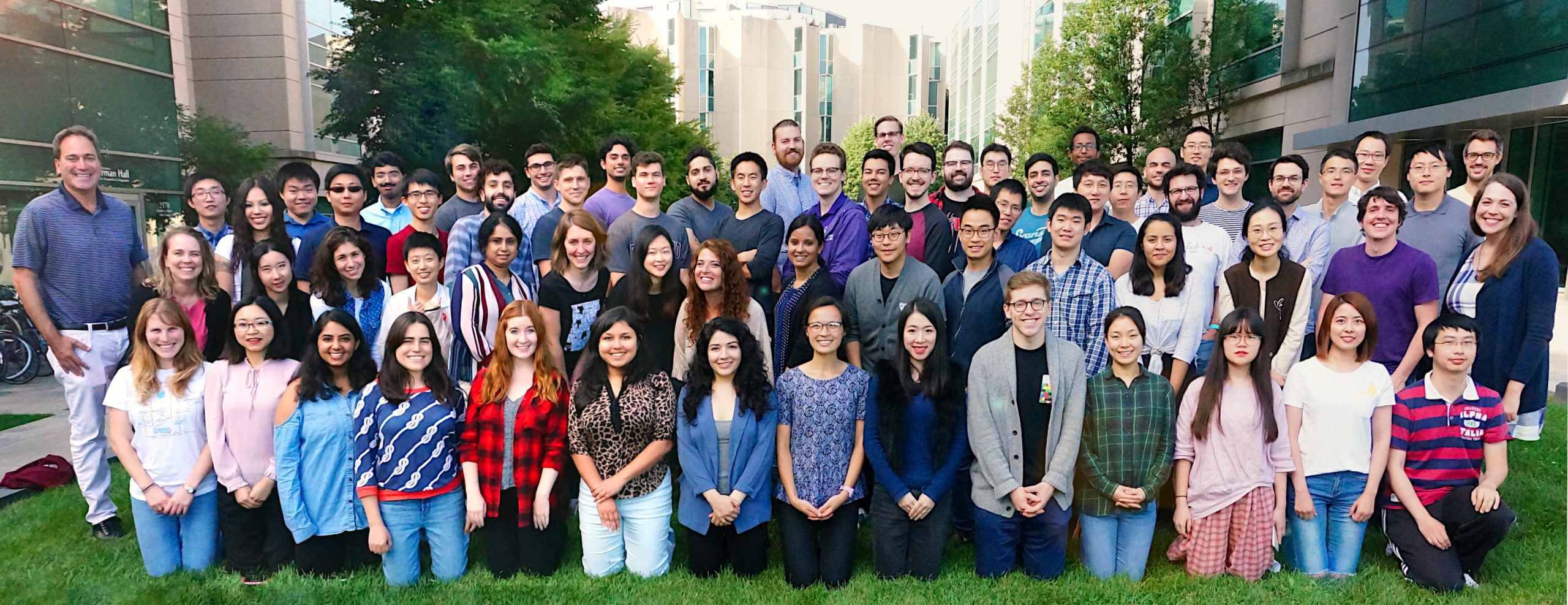
Subgroup Members (Left to Right):

(Back Row) Matt Park, Xiaodong Chen, Ling Huang, Jae-Won Jang, Fengwei Huo, Wei Wei, Jong Kuk Lim, Andrea Ho (Espinosa Group at NU)

(Front Row) Rafael Vega, Andrew Senesi, Raymond Sanedrin, Louise Giam, Yuhuang Wang


Dip-Pen Nanolithography: Transport of molecules to the surface via water meniscus.

    Surface science in the Mirkin Group is primarily focused on the development and exploration of applications for Dip-Pen Nanolithography (DPN), the new AFM-based soft-lithography technique which was invented in our labs.  Dip-Pen Nanolithography (DPN) is a scanning probe nanopatterning technique in which an AFM tip is used to deliver molecules to a surface via a solvent meniscus, which naturally forms in the ambient atmosphere.  This direct-write technique offers high-resolution patterning capabilities for a number of molecular and biomolecular 'inks' on a variety of substrates, such as metals, semiconductors, and monolayer functionalized surfaces. It's becoming a work-horse tool for the scientist interested in fabricating and studying soft- and hard-matter on the sub-100nm length scale.

DPN allows one to precisely pattern multiple patterns with near-perfect registration. It's both a fabrication and imaging tool, as the patterned areas can be imaged with clean or ink-coated tips. The ability to achieve precise alignment of multiple patterns is an additional advantage earned by using an AFM tip to write, as well as read nanoscopic features on a surface.  These attributes make DPN a valuable tool for studying fundamental issues in colloid chemistry, surface science, and nanotechnology. For instance, diffusion and capillarity on a surface at the nanometer level, organization and crystallization of particles onto chemical or biomolecular templates, monolayer etching resists for semiconductors, and nanometer-sized tethered polymer structures can be investigated using this technique.     

How does DPN work?

    In order to create stable nanostructures, it's beneficial to use molecules that can anchor themselves to the substrate via chemisorption or electrostatic interactions. When alkanethiols are patterned on a gold substrate, a monolayer is formed in which the thiol headgroups form relatively strong bonds to the gold and the alkane chains extend roughly perpendicular to surface. 
 

 A) AFM image showing lattice-resolved monolayer of octadecanethiol patterned on gold via DPN.  B) A movie showing the formation of an octadecanethiol monolayer on Au as an ODT-coated tip raster scanned across the substrate.

The thiol lattice formed is identical to that of a monolayer obtained via solution deposition of alkanethiols on gold, as seen in the lattice image above.  We are able to use this technique to directly monitor the growth of a monolayer of alkanethiols on gold by delivering the molecules via DPN and imaging in situ with AFM, see movie above.

What are the attributes of DPN?

     Creating nanostructures using DPN is a single step process which does not require the use of resists. Using a conventional atomic force microscope (AFM) it is possible to achieve ultra-high resolution features with linewidths as small as 10-15 nm with ~ 5 nm spatial resolution. For nanotechnological applications, it is not only important to pattern molecules in high resolution, but also to functionalize surfaces with patterns of two or more components.
 

A) Ultra-high resolution pattern of mercaptohexadecanoic acid on atomically-flat gold surface. B) DPN generated multi-component nanostructure with two aligned alkanethiol patterns. C) Richard Feynmann's historic speech written using the DPN nanoplotter.

     One of the most important attributes of DPN is that, because the same device is used to image and write a pattern, patterns of multiple molecular inks can be formed or aligned on the same substrate. With the aid of software created in-house (which has been commercialized through NanoInk), we have devised a nanolithographic tool which is ink-general and allows for simple registration of inks. Also, the contamination which could result from typical lithographic techniques (such as photolithography), is avoided.


What are the applications of DPN?

     We are currently using DPN to probe fundamental surface science questions as well as to create technologically relevant nanostructures.  Some of the applications that we are targeting are depicted in the figure below.  Part of the process of investigating these technological applications requires that we develop methods which will allow parallel patterning in addition to the serial capabilities of DPN.  In addition, we have to develop procedures to pattern on semiconductor and insulator substrates as well as metals, and also extend the choice of inks past small molecules to biological polymers and conducting organic macromolecules.
 

Some of the potential applications of DPN. This technique allows one to create a large variety of systems with a single lithographic setup.


Protein Nanoarrays via DPN

Protein arrays have proven integral to a range of applications in biological research, proteomics, and high-throughput pharmaceutical screening processes. Protein microarrays, for example, can be used to investigate protein interactions with proteins, haptens, DNA, and RNA, which are important to probe protein function and regulation, and even can be extended to the study of diseases such as prostate cancer and Alzheimer's disease. However, several intrinsic problems of current protein arrays such as quantity of sample, specificity, and nonspecific binding should be addressed for practical applications. For proteomic profiling, preparing small and extremely dense protein chips could provide a major advantage over today's microdevice technology. Significantly higher densities of target elements as well as better detection limits can be achieved through further miniaturization of protein arrays via DPN. Proof-of-concept experiments of bio-nanoarrays using DPN can be found in the recent literature to construct nanoarrays of proteins via indirect methods with 100 nm features, and to probe biological interactions within a nanostructure with a conventional AFM. In addition, several studies have been reported for the direct deposition of proteins, which has advantages over indirect methods including time required and ease of fabrication, most importantly, the ability to fabricate arrays with multiple protein features.

(Left) AFM images of (A) Lysozyme nanodot arrays, (B) IgG nanodot arrays, an IgG nanodot array before (C) and after (D) treatment with a solution anti-IgG coated Au nanoparticles. (Right) Fluorescence microscopic image of protein arrays after binding with anti-body labeled with fluorophore.

Protein DPN References

Lee,K.-B.; Park, S.-J.; Mirkin, C. A.; Smith, J. C.; Mrksich, M. "Protein Nanoarrays Generated by Dip-Pen Nanolithography," Science, 2002,295(5560), 1702-1705.

Lee, K-B.; Lim, J-H.; Mirkin, C.A. “Protein Nanostructures Formed Via Direct-Write Dip-Pen Nanolithography” J. Am. Chem. Soc. 2003, 125, 5588-5589.

Lim, J-H.; Ginger, D.S.; Lee, K-B.; Heo, J.; Nam, J-M.; Mirkin, C.A. “Direct-Write Dip- Pen Nanolithography of Proteins on Modified Silicon Oxide Surfaces,” Angew. Chem. Int. Ed. 2003, 20, 2411-2414.


Electrochemical Whittling of Organic Nanostructures

One approach to fabricating highly miniaturized organic nanostructures is to develop procedures that controllably reduce the size of an existing organic structures. Recently, we developed an approach called  "electrochemical whittling". Recent studies have indicated that the electrochemical desorption of SAMs on a gold surface is initiated from defect sites within a monolayer. The bare gold surface surrounding the close-packed SAMs generated by DPN is effectively a large defect site. Therefore, by applying a potential in a controlled manner, one can selectively shrink features comprised of densely packed monolayer structures. In general, we find that one can shrink a structure by 5~10 times (in diameter) without significant distortion.
 

A) Schematic drawing of electrochemical whittling. B) LFM images of MHA patterns before and after electrochemical whittling. C) By controlling the electrochemical conditions, the size of MHA dots can be reduced, step-by-step, on the nanometer scale. D) Although there is no direct evidence for the uniformity of the monolayers after the whittling process, an etching study suggests that the resulting organic films can act as effective barrier layers for chemical etchants.

Electrochemical Whittling Reference

Zhang, Yi; Salaita, Khalid; Lim, Jung-Hyurk; Mirkin, Chad A. "Electrochemical Whittling of Organic Nanostructures," Nano Lett., 2002, 2(12), 1389-1392.


Electrostatically Driven DPN of Conducting Polymers

We can deposit nanoscale conducting polymer patterns on semiconductor surfaces using DPN.  Significantly, we show that electrostatic interactions between water soluble ink materials and charged substrates can provide a significant driving force for the generation of stable DPN patterns on semiconductor surfaces.  Characterization of the patterned conducting polymers was performed by LFM and electrochemical methods, the results of which are fully consistent with the conclusion that conducting polymer molecules can be successfully transported from the tip to these types of charged surfaces.
 

LFM and AFM images of DPN-generated conducting polymer nanostructures on modified silicon surfaces.  All images were recorded at a scan rate of 4 Hz.  (A) LFM image of a SPAN nanopattern written at 0.85 mm/s.  (B) LFM image of PPy nanopattern written at 0.8 mm/s. (C) Topography image of SPAN dots and the cross-sectional profile of the line.  The contact time was 6 seconds for each dot.  (D) Topography image of PPy lines at 0.5 mm/s and the cross-sectional profile of the line.

Electrostatically Driven Patterning Reference

Lim, Jung-Hyurk; Mirkin, Chad A. "Electrostatically Driven Dip-Pen Nanolithography of Conducting Polymers," Adv. Mat., 2002, 14(20), 1474-1477. 


Surface and Site-Specific Ring-Opening Metathesis Polymerization (ROMP) Initiated via DPN

A novel approach for synthesizing arrays of nanoscale polymer brushes, based upon a combination of DPN and a surface-initiated ROMP method, has been demonstrated on metallic and insulating substrates.  These approaches are important because they point towards a route to combinatorial libraries of functional polymer nanostructures of almost limitless chemical complexity, which can be constructed in situ.  The capabilities demonstrated via these single-pen experiments will be dramatically facilitated through the use of multi-pen arrays that do not require the step-by-step changing of inks and pens during a conventional DPN experiment.

(Left) Graphical representation of surface-initiated ROMP via DPN. (Right) Polymer brush nanostructures prepared according to Scheme: a) Topographic AFM image of polymer brush lines.  The speed of norbornenyl thiol deposition, polymerization time, and measured average full width at half maximum (FWHM) values are 0.02 mm/s, 60 min, and 480 nm, respectively; b) Cross-sectional topography trace for a selected line from a; c) Topographic AFM image of a polymer brush dot array.  The norbornenyl thiol deposition and polymerization times are 1 s and 30 min, respectively; d) Cross-sectional topography trace for a selected line from c.

ROMP via DPN Reference

Liu, X.; Guo, S.; Mirkin, C.A. “Surface and Site-Specific Ring-Opening Metathesis Polymerization Initiated by Dip-Pen Nanolithography” Angew. Chem. Int. Ed. 2003, 115, 4933-4937.


DPN-Based Methodology for Preparing Arrays of Nanostructures

We can easily use DPN to fabricate functionalized arrays of inorganic nanopatterns. Importantly, through the photooxidation of the SAM resists, chemically active nanostructures can be generated. These structures can be modified with alkanethiol-capped oligonucleotides which retain their hybridization properties on the surfaces of the nanopatterns and react with complementary DNA or particles modified with complementary DNA. This type of procedure might be useful for generating hybrid soft/hard structures composed of metal nanofeatures interfaced with adsorbates that exhibit a high chemical affinity for them.
 

(Left) Experimental scheme of Au nanostructure fabrication via DPN. (Right) (A) Illustration of three-strand DNA hybridization scheme. (B) TMAFM image of line features after hybridization with DNA (b)-modified nanoparticles. (C) High-resolution image of one of the lines in B. (D) TMAFM image of dot features after hybridization with DNA (b)-modified nanoparticles. (E) High-resolution image of 4 dots of the features in D.

Biofunctionalized Nanoarrays Reference

Zhang, H.; Lee, K.-B.; Li, Z.; Mirkin, C. A. “Biofunctionalized Nanoarrays of Inorganic Structures Prepared by Dip-Pen Nanolithography,” Nanotechnology 2003, 14, 1113-1117.

For all DPN references, click here.

To return to the Mirkin Group Home Page, click here.